

📈 CAC is rising for Indian D2C Brands — what Smart Brands are doing differently ?
Across India’s D2C ecosystem, founders and growth teams are noticing the same pattern:
The same marketing budget is no longer bringing the same number of customers.
This is not anecdotal.
Industry insights from RedSeer Strategy Consultants indicate that many Indian D2C brands have experienced ~25–30% increase in acquisition spend required to sustain growth as digital competition intensifies.
At the same time, McKinsey & Company estimates that companies lose 20–30% of marketing spend due to fragmented tools, poor data integration, and incorrect attribution.
⚠️ This is a structural shift in digital marketing economics — not a temporary fluctuation.
🔍 Why CAC Is Structurally Increasing
1️⃣ The cost of attention has gone up
Gartner’s marketing trend analysis shows that as more brands compete for the same user attention on Meta, Google and other platforms, auction prices naturally inflate.
Even good ads now cost more to distribute.
2️⃣ Targeting is less precise than before
Privacy changes and reduced third-party tracking have made paid targeting broader. Brands must now test more audiences and creatives before finding efficient combinations — increasing acquisition cost before optimization happens.
3️⃣ Creative fatigue is now part of CAC
Gartner also highlights declining engagement with repetitive creatives. Brands are required to produce continuous creative variations, especially video and UGC formats, just to maintain performance.
🎨 CAC now includes creative velocity, not just media spend.
🧠 What McKinsey Observes: CAC Is Influenced by What Happens After the Click
McKinsey’s research on personalization and lifecycle marketing reveals a crucial insight:
Brands that connect acquisition with engagement and retention generate significantly better marketing ROI than brands that optimize acquisition alone.
In other words, CAC performance today depends heavily on the system around the ad, not just the ad itself.
🚀 What Smart D2C Brands Are Doing Differently
The brands managing CAC well are not cutting paid campaigns.
They are changing the marketing system around paid campaigns.
✅ 1. Content familiarity improves paid performance
When brands build organic familiarity through short-form video, education, storytelling and creator content, paid ads perform better:
- Higher relevance scores
- Better engagement
- Lower cost per result over time
Paid ads become more efficient when the audience already recognizes the brand.
✅ 2. India’s WhatsApp advantage is becoming a CAC lever
India has over 500 million WhatsApp users, making it one of the most powerful owned communication channels available to D2C brands. With ~98% open rates, WhatsApp remains an important lever of marketing and growth.
When brands use WhatsApp for post-purchase engagement, re-activation, and personalized communication, repeat purchases happen without requiring paid reacquisition.
This reduces continuous pressure on paid channels.
✅ 3. AI is increasing creative velocity — and making it targeted
Gartner’s research on Generative AI in marketing highlights how brands are now able to:
- Rapidly generate multiple creative variations
- Tailor creatives to audience segments
- Test faster without heavy production cycles
This protects CAC from rising due to creative fatigue.
✅ 4. Personalization improves conversion across all channels
McKinsey reports that companies excelling at personalization generate 40% more revenue from those efforts than average players.
When website experience, emails, ads and offers reflect user behavior, every paid click becomes more valuable.
✅ 5. Unified data enables smarter budget allocation
McKinsey’s marketing analytics research shows that brands with integrated data visibility reduce wasted spend and allocate budgets more effectively across audiences and channels.
Without unified visibility, CAC optimization becomes guesswork.
📘 The Modern CAC Playbook
| 🎯 Focus Area | 💡 Why It Reduces CAC Pressure |
|---|---|
| Frequent creative refresh (AI-assisted) | Prevents ad fatigue and maintains engagement levels |
| Content familiarity | Improves paid efficiency as audiences already recognize the brand |
| WhatsApp engagement | Drives repeat revenue without paid reacquisition |
| Personalization | Improves conversion rates across all touchpoints |
| Unified analytics | Enables smarter, data-backed budget allocation |
| Lifecycle engagement | Increases customer value beyond the first purchase |
⚙️ The Real Challenge Is Operational
Most founders understand these ideas.
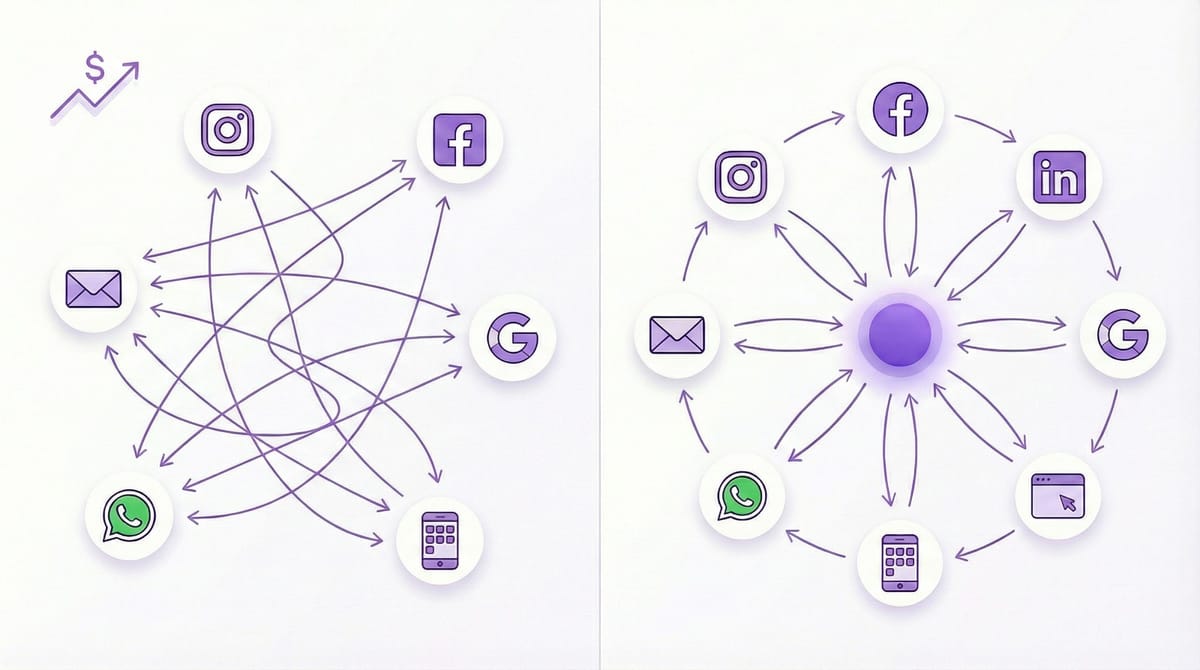
The difficulty is executing content, ads, landing pages, tracking, email journeys, WhatsApp flows, analytics and engagement across multiple disconnected tools.
🧩 This fragmentation makes CAC harder to control.
🌐 Our Vision for D2C and SMB Growth
D2C brands and SMBs do not lack ideas, effort, or marketing intent.
What they often lack is a connected system where:
- Content informs paid campaigns
- Paid campaigns inform lifecycle journeys
- Customer behavior informs personalization
- WhatsApp, Email, Website, Ads and Analytics work from the same customer story
Our vision at Agentcord is to enable D2C and SMB teams to operate marketing as one unified growth system instead of multiple disconnected activities.
Not by adding more tools — but by connecting execution, data, content, engagement and analytics into a single operational flow that makes modern CAC control practically achievable.
🧾 Conclusion
CAC is rising. That is structural.
But brands feeling the most pressure are those treating paid ads as the only lever.
Brands combining:
- Content
- WhatsApp engagement
- AI-driven creatives
- Personalization
- Unified data
- Integrated execution
are managing CAC far more effectively.
🏆 That defines efficient D2C growth in 2026–27.